



















What Is a Dummy Ticket? The Complete updated 2026 Guide to Flight Reservations for Visa Applications
-
Dummy Ticket Team
- June 26, 2026
- 16 min read


Planning an international trip often feels like solving a puzzle with a missing piece: you need a visa to travel, but many embassies want to see your flight itinerary before they’ll grant one. So what are you supposed to do — buy a non-refundable ticket before you even know if you’ll be allowed in? A dummy ticket is the practical, legal solution millions of travelers use every year. This guide explains everything you need to know.
Table of Contents
- What Is a Dummy Ticket? (The Clear Definition)
- How a Dummy Ticket Works — PNR, GDS & Verification
- Dummy Ticket vs. Real Ticket: Key Differences
- Why Travelers Use Dummy Tickets for Visa Applications
- Which Countries Accept a Dummy Ticket?
- How to Get a Dummy Ticket — Step by Step
- Is a Dummy Ticket Legal? (The Honest Answer)
- 7 Mistakes to Avoid With Dummy Tickets
- Frequently Asked Questions
- Conclusion & Next Steps
What Is a Dummy Ticket? (The Clear Definition)
A dummy ticket is a temporary, verifiable flight reservation that includes a real booking reference number (PNR), passenger name, and full itinerary — but does not require full payment. It is used primarily as proof of onward or return travel for visa applications, border checks, and immigration requirements.
Despite the word “dummy,” there is nothing fake about a properly issued dummy ticket. The term simply refers to the temporary nature of the reservation: it holds a seat on a real flight in the airline’s global distribution system (GDS) for a limited period — typically 24 hours to 48 days — before automatically expiring if not converted into a paid booking.
The key elements of a legitimate dummy ticket include:
- Passenger Name Record (PNR): A unique alphanumeric code (e.g., “XK7M2Q”) that embassy officers or airline staff can verify in real time through systems like Amadeus, Sabre, or Galileo.
- Full flight itinerary: Airline, flight number, origin and destination airports, departure and arrival dates and times.
- Passenger details: Full legal name as it appears on the passport.
- Booking class and seat allocation (in most cases).
Because the PNR links to a live entry in an airline’s or GDS’s reservation database, consular officers can independently confirm the reservation is real — which is exactly what distinguishes a dummy ticket from a counterfeit or forged document.
“A dummy ticket is not a fake ticket. It is a genuine, time-limited flight reservation. The distinction matters enormously — both legally and practically.”
Other Names You Might See for a Dummy Ticket
The travel industry uses several terms interchangeably for the same concept. You may encounter:
- Flight reservation for visa — the most embassy-friendly phrasing
- Onward ticket — emphasizes proof of departure from the destination country
- Temporary flight reservation — highlights its short-term nature
- Proof of onward travel — commonly required at borders, especially in Southeast Asia
- Flight itinerary for visa — preferred terminology in official government guidance
All of these refer to the same instrument: a verifiable, temporary booking that proves travel intent without the financial commitment of a fully paid ticket.
2. How a Dummy Ticket Works — PNR, GDS & Verification
Understanding the technical backbone of a dummy ticket helps you choose a reliable provider and assures you the document will hold up under embassy scrutiny.
The Global Distribution System (GDS)
When a travel agent or online booking platform creates a flight reservation, it is entered into one of the major Global Distribution Systems: Amadeus, Sabre, or Travelport (Galileo/Worldspan). These are massive, interconnected databases that airlines and travel agents worldwide use to manage inventory. Every confirmed or held reservation generates a PNR that anyone with system access — including consular staff — can query.
A dummy ticket issued through a legitimate provider creates a real entry in one of these GDS databases. The reservation is “held” against a seat, meaning the airline reserves that seat for the passenger temporarily. This is identical to how a real booking starts — the only difference is that payment is not collected, and the hold expires after a set period.
PNR Verification — What Embassies Actually Check
When a consular officer reviews your visa application, they may verify your flight reservation in several ways:
- Online airline “Manage My Booking” portal: Most airlines allow anyone to look up a PNR by entering it alongside the passenger’s surname.
- GDS terminal lookup: Many embassy visa sections have direct GDS access and can perform deep database queries.
- Calling the airline: Some consulates confirm reservations by phone with the airline’s reservations desk.
This is why using a reputable dummy ticket provider that books through a genuine GDS is non-negotiable. Services that simply generate a PDF document with a made-up PNR are producing forged travel documents — which is illegal and can result in visa denial, a permanent ban, or criminal prosecution.
How Long Is a Dummy Ticket Valid?
The hold period depends on the airline, the fare class, and how the reservation was created:
- 24–48 hours: The most common window, especially for low-cost carriers and economy class holds.
- 72 hours: Standard for many full-service carriers when booked via GDS.
- 7–14 days: Available from specialist dummy ticket providers who use special agent-level fare holds or refundable booking techniques.
Practical tip: Always submit your visa application within 24–48 hours of obtaining your dummy ticket if it has a short validity window. Better providers will tell you exactly when your PNR expires — and some offer free renewals if processing is delayed.
Dummy Ticket vs. Real Ticket: Key Differences at a Glance
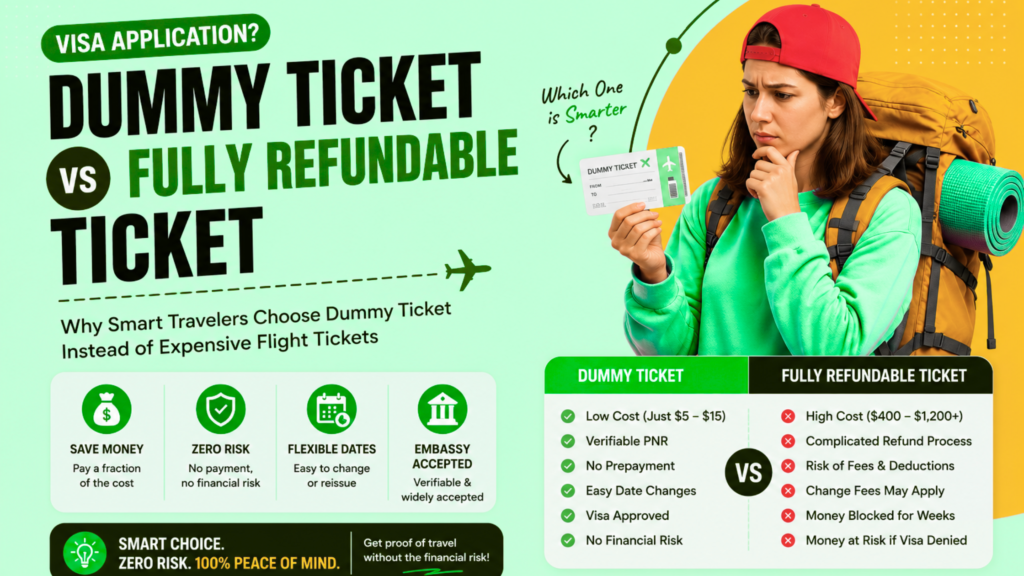
Travelers sometimes wonder whether to simply buy a refundable ticket for visa purposes and cancel afterward. Here is a clear side-by-side comparison:
| Feature | Dummy Ticket | Real (Paid) Ticket | Refundable Real Ticket |
| Verifiable PNR | ✔ Yes | ✔ Yes | ✔ Yes |
| Accepted by embassies | ✔ Yes (if GDS-based) | ✔ Yes | ✔ Yes |
| Upfront cost | $5–$20 | $200–$2,000+ | $300–$3,000+ |
| Financial risk if visa denied | ✔ None | ✘ High (non-refundable) | ⚠ Low–Medium |
| Flexibility to change dates | ✔ Full (new reservation) | ✘ Change fees apply | ⚠ Partial (admin fees) |
| Validity period | 24 hrs – 48 Hours | Per fare rules | Per fare rules |
| Can board the flight | ✘ No (unpaid) | ✔ Yes | ✔ Yes |
Bottom line: For visa application purposes, a dummy ticket provides identical documentary proof to a real ticket — at a fraction of the cost and without any financial risk. Once your visa is approved, you book the actual flights you want, on the dates that suit you.
Why Travelers Use Dummy Tickets for Visa Applications
The case for a dummy ticket is partly financial, partly practical — and increasingly, it’s what embassies themselves recommend.
1. Embassies Explicitly Ask for a “Flight Reservation,” Not a Paid Ticket
The official Schengen visa checklist\ published by European consulates consistently asks for “a copy of return or round-trip flight reservations” — not proof of payment. The UK Home Office, US State Department visa guidelines, and many Asian embassies use identical language. Buying a fully paid ticket to satisfy this requirement is not only unnecessary — it’s a financial gamble.
2. Visa Denials Are a Real Risk — Don’t Buy Before You’re Approved
Global visa rejection rates paint a sobering picture. In 2024, the Schengen area rejected approximately 12% of all short-stay visa applications — over 2 million people. First-time applicants, those with limited travel history, or those applying from high-scrutiny countries face significantly higher denial rates. Purchasing a non-refundable $800 round-trip flight before receiving a visa approval is simply imprudent financial planning.
3. Processing Times Are Unpredictable
Visa processing times fluctuate with embassy workloads, seasonal demand, and geopolitical events. A dummy ticket allows you to submit your application immediately with a plausible itinerary, then book your actual flights once you have the visa stamp in hand — choosing the best prices and timing available at that point.
4. Proof of Onward Travel at the Border
Beyond visa applications, many countries — particularly in Southeast Asia (Thailand, Indonesia, Malaysia) — require travelers to show proof of onward travel at the point of entry, even for visa-free or visa-on-arrival nationalities. Airlines also enforce this rule during check-in. A dummy ticket satisfies both requirements instantly.
5. Cost Savings Are Substantial
A verifiable dummy ticket typically costs between $5 and $20, with most reputable providers charging under $15. Compare this to even the cheapest refundable flight option, and the savings are obvious — particularly for travelers applying to multiple visa jurisdictions or making multiple applications per year.
Which Countries Accept a Dummy Ticket for Visa?
The short answer: the vast majority of countries that require flight proof accept a flight reservation rather than a confirmed ticket. Here is a region-by-region overview:
🇪🇺 Schengen Area (26 Countries)
The Schengen visa application officially requires “flight reservation” — not a purchased ticket. Embassies for France, Germany, Spain, Italy, the Netherlands, and others all accept dummy tickets as standard. The reservation must show entry into and exit from the Schengen Zone within the intended travel period.
🇬🇧 United Kingdom
The UK Standard Visitor Visa application requires travel plans, but immigration guidance makes clear that a firm booking is not necessary at the application stage. A verifiable flight reservation is accepted.
🇺🇸 United States
The DS-160 nonimmigrant visa application asks for “intended date of arrival in the US” — it does not require proof of a paid ticket. However, having a realistic itinerary (which a dummy ticket provides) strengthens your application and supports your cover letter’s statements.
🇨🇦 Canada
Canadian visa applications (Temporary Resident Visa) similarly accept a flight itinerary. IRCC (Immigration, Refugees and Citizenship Canada) does not mandate a paid ticket at the application stage.
🌏 Southeast Asia (Border Entry)
Thailand, Indonesia, Malaysia, the Philippines, and several other Southeast Asian nations require proof of onward travel at the border or during airline check-in. A dummy ticket is the most practical and cost-effective way to satisfy this — especially for travelers on multi-country itineraries who haven’t yet confirmed their next destination.
🌍 Other Regions
Most countries in the Middle East (UAE, Saudi Arabia, Egypt), Africa (Morocco, Kenya, South Africa), and Latin America follow the same “flight reservation” standard for visa applications. Always check the specific embassy website for the destination country, as requirements can change.
Important: While dummy tickets are widely accepted, always verify current requirements directly on the official embassy or consulate website of your destination country before applying. Requirements can be updated without notice.
How to Get a Dummy Ticket — Step by Step
Getting a dummy ticket from a reputable provider takes under 10 minutes. Here’s the standard process:
Step 1 — Choose a reputable provider Look for services that explicitly state they book through GDS systems (Amadeus, Sabre, or Travelport) and provide a verifiable PNR. Read reviews and confirm their cancellation and renewal policy.
Step 2 — Enter your travel details Provide your full name exactly as it appears in your passport, desired departure and return cities, and preferred travel dates. Dates should align with your intended visa period — typically within 3–6 months.
Step 3 — Make payment Pay the service fee (typically $5–$20). Reputable services never charge airline ticket prices — if a provider asks for hundreds of dollars, that’s a red flag.
Step 4 — Receive your reservation document You’ll receive a PDF with the itinerary, PNR, passenger name, flight details, and airline logo. Typically delivered within minutes to a few hours.
Step 5 — Verify the PNR yourself Go to the airline’s “Manage My Booking” page and enter the PNR and your last name. Confirm it shows up correctly. If it doesn’t, contact the provider immediately.
Step 6 — Submit with your visa application Include the printed dummy ticket PDF in your application package. Submit promptly — before the PNR hold expires.
Step 7 — Book real flights after visa approval Once your visa is approved, book the actual flights you want. You’re now free to choose the best dates, airlines, and prices without the pressure of a pre-existing non-refundable commitment.
What to Look for in a Dummy Ticket Provider
- ✅ GDS-backed reservations with real, verifiable PNR codes
- ✅ Clear validity period stated upfront (with free renewal option)
- ✅ Delivery within 1–2 hours at most
- ✅ Customer support via chat, email, or phone
- ✅ Transparent pricing with no hidden fees
- ✅ Positive reviews from verified traveler communities (Reddit, TripAdvisor, Trustpilot)
7. Is a Dummy Ticket Legal? (The Honest, Nuanced Answer)
This is the question every first-time dummy ticket user asks — and it deserves a clear, honest answer rather than vague reassurance.
The Short Answer: Yes, With One Critical Condition
A dummy ticket is legal as long as it represents a genuine reservation in the airline system. A temporary, GDS-held booking is a standard feature of how the global air travel infrastructure works. Travel agents routinely hold reservations for clients before payment is finalized. Using this mechanism to generate a verifiable itinerary for visa purposes is entirely within the rules of the system.
Where It Becomes Illegal
The legality line is crossed when a document is fabricated — i.e., when a PNR is invented, forged, or generated by software that has no connection to a real airline database. Submitting such a document to an embassy is fraud. Consequences can include:
- Immediate visa denial and a note on your immigration record
- Multi-year or permanent visa ban from the destination country
- Criminal prosecution under the laws of both your home country and the destination
- Being added to airline and immigration watchlists
⚠ Critical Warning: Never use a service that generates a PDF with a fake or unverifiable PNR. Always verify your PNR on the airline’s official website before submitting your application. If the PNR doesn’t resolve to a real booking, do not use the document.
The Ethical Dimension
Some travelers feel uncomfortable with the concept because it involves presenting a reservation they don’t intend to honor. In practice, embassies understand that travel plans change — they are assessing whether your stated travel intent is plausible, not locking you into a specific seat. What matters is that your travel intentions are genuine and that the document you submit is verifiably real.
7 Common Mistakes to Avoid With Dummy Tickets
- Using a provider that generates fake PNRs. Always verify the PNR is live on the airline’s system. This is the single most important check you can perform.
- Waiting too long to submit your application. If your PNR has a 48-hour hold and you submit on day three, the reservation may have expired. Submit immediately after receiving your dummy ticket.
- Inconsistent dates between documents. Your dummy ticket dates must be consistent with your hotel bookings, travel insurance, and the duration stated in your cover letter. Discrepancies are a major red flag for consular officers.
- Using a one-way ticket when a return is required. Most countries require both inbound and outbound legs. Confirm the specific requirement for your destination.
- Selecting unrealistic routing. If you’re applying for a German Schengen visa, your itinerary should reflect entry into and exit from Germany (or at least the Schengen zone), not an unrelated route.
- Ignoring the name field. The name on your dummy ticket must exactly match your passport — including middle names if your passport includes them, and correct spelling throughout.
- Forgetting to book real flights after visa approval. Your dummy ticket cannot be used to board the plane. Once approved, book your actual flights promptly to secure the best fares.
Frequently Asked Questions About Dummy Tickets
Can I use a dummy ticket to board a flight? No. A dummy ticket is an unpaid reservation. Without full payment, the airline will not issue a boarding pass. You must purchase a real ticket separately when you’re ready to travel.
How much does a dummy ticket cost? Reputable providers charge a service fee of approximately $5–$20 USD. This is not a payment toward the flight — it covers the administrative cost of creating and holding the GDS reservation on your behalf.
Will the embassy know my ticket hasn’t been paid for? Embassies check that the PNR is verifiable and that the itinerary is plausible — they do not systematically verify whether a booking has been paid. What matters is that the reservation exists in the system at the time of verification.
What happens if my dummy ticket expires before my visa is processed? Most reputable providers offer free or low-cost renewal. Contact your provider before the PNR expires and request a renewal or new reservation. Do not submit an expired PNR.
Can I use a dummy ticket for proof of onward travel at the airport? Yes — provided the PNR is still active at the time of check-in or border crossing. Airlines and immigration officials can look up the booking in the same way embassies do. Always ensure your dummy ticket is still valid when you travel.
Are there any countries that specifically prohibit dummy tickets? No country has officially banned flight reservations as a visa document — because a genuine reservation (as opposed to a forgery) is a standard travel industry mechanism. The risk is not from the concept of a dummy ticket but from using fraudulent documents.
Is a dummy ticket the same as travel insurance for visa purposes? No. Travel insurance and dummy tickets serve different purposes. Many visa applications — especially Schengen — require both a flight reservation and travel insurance covering the duration of the trip. Check requirements for each individually.
Conclusion: Dummy Tickets Make Smart Travel Planning Possible
A dummy ticket is one of the most practical tools in the modern traveler’s toolkit. It bridges the gap between the embassy’s requirement for a travel itinerary and the financial prudence of not purchasing non-refundable flights before you have a visa in hand. When obtained from a legitimate provider that creates genuine GDS reservations with verifiable PNRs, a dummy ticket is legal, accepted by embassies worldwide, and an entirely sensible approach to visa documentation.
The key takeaways from this guide:
- A dummy ticket is a real but temporary flight reservation — not a fake or forged document.
- It includes a verifiable PNR that embassy officers can check in real time.
- It is accepted for Schengen, UK, US, Canadian, and most other visa applications.
- It costs $5–$20 and protects you from losing hundreds of dollars on non-refundable flights if your visa is denied.
- Legality depends entirely on the PNR being genuinely held in an airline’s GDS — never use providers generating fake codes.
- After visa approval, book your actual flights freely, on your preferred dates, at the best available prices.
For travelers planning complex multi-country itineraries, budget-conscious explorers, first-time visa applicants, and anyone unwilling to gamble hundreds of dollars on a visa outcome they can’t control, a dummy ticket is simply the logical choice.
Ready to Get Your Dummy Ticket?
Generate a verifiable, GDS-backed flight reservation in under 10 minutes. Instant delivery, real PNR, embassy-ready format.
➡ Generate My Dummy Ticket Now at Dummy-Tickets.com