




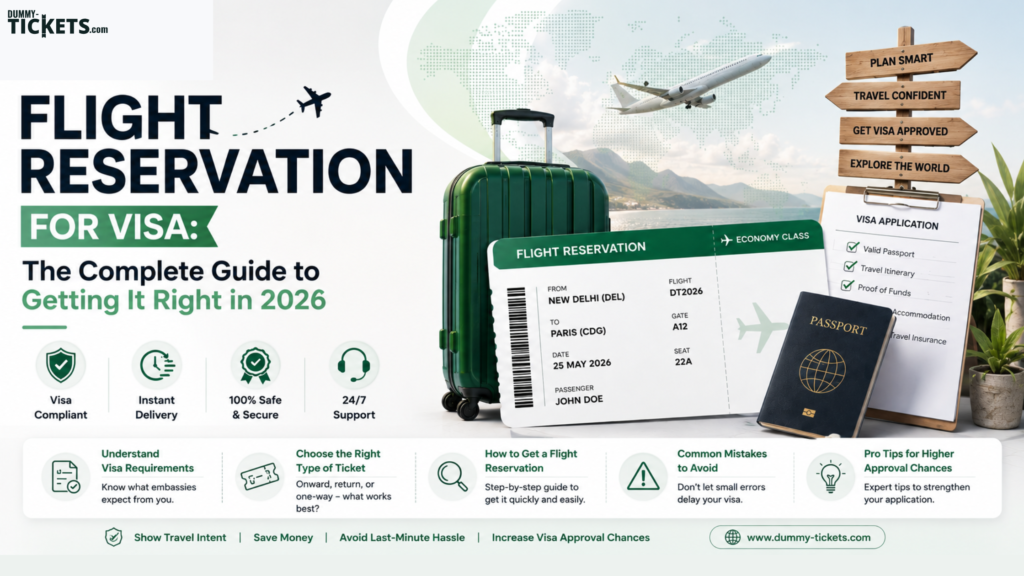











Flight Reservation for Visa: The Complete Guide to Getting It Right in 2026
-
Dummy Ticket Team
- August 6, 2026
- 12 min read

Somewhere on your visa checklist sits a line that trips up more applicants than almost any other: “proof of travel arrangements” or “flight itinerary.” It sounds like it means buy a plane ticket. It doesn’t and misreading that one line has cost travelers thousands of dollars on non-refundable flights for trips their visa never approved.
A flight reservation for visa purposes is a real, verifiable flight booking used to demonstrate your travel plans to an embassy or consulate without the financial risk of purchasing a ticket you might never use. This guide explains exactly what counts as valid proof, what the actual regulations say (not just what travel blogs claim), how requirements differ across Schengen, US, UK, and Canadian visas, and how to get a compliant reservation without gambling on a purchase you can’t undo. If you have an application deadline or interview coming up, read this before you touch your credit card.
What Is a Flight Reservation for Visa? A Clear Definition
A flight reservation for a visa is a confirmed booking carrying a real, verifiable PNR (Passenger Name Record) code in an airline’s reservation system that shows your planned entry and exit dates for the country you’re applying to visit. It’s built to answer one specific question a visa officer needs answered: do you have a coherent, realistic plan to leave before your permitted stay ends?
Critically, it does not have to be a fully paid e-ticket. Embassies distinguish clearly between:
- A flight reservation (or itinerary): a real booking held in an airline or GDS (Global Distribution System) database, verifiable by PNR, that hasn’t necessarily been paid for in full.
- A paid/confirmed ticket: a ticket that’s been fully purchased and issued, non-refundable in most cases, and ready to fly on.
Flight Reservation vs. Flight Itinerary vs. Onward Ticket
These three terms get used interchangeably, but the distinction matters depending on where you’re applying:
- Flight reservation / itinerary is the term embassies use during the visa application stage; it’s a document you submit alongside your other paperwork.
- Onward ticket (or proof of onward travel) is the term used at the airport or border, once you’re already traveling, to satisfy airline check-in staff or immigration officers on arrival. If you’re researching that side of the process, our complete onward ticket guide covers it in depth.
- A paid ticket is simply the final purchase, something you should generally hold off on until your visa decision is in hand.
In practice, a well-built flight reservation can satisfy both use cases, but the audience is different: one is reviewed by a consular officer at your application stage, the other is checked by an airline agent or immigration officer once you’re actually flying.
Why Embassies Ask for a Flight Reservation for Visa Not a Actual Paid Ticket
Understanding the logic behind this requirement makes the whole process far less confusing.
The Legal Basis: What the Rules Actually Say
For the Schengen Area, the requirement traces directly to the EU’s Visa Code. Under Regulation (EC) No 810/2009 (the Visa Code), Article 14, applicants must provide supporting documents indicating their travel plans — the regulation’s own wording refers to confirmation of a booking or “any other appropriate document indicating the envisaged travel plans,” not proof of a completed purchase. This is the actual legal text most reservation-service blogs paraphrase without linking to.
Other countries follow the same logic without a single unified law behind it. The US Department of State’s own visitor visa guidance is unambiguous: applicants should “not make final travel plans or buy tickets until you have a visa”. UK Visas and Immigration and Canada’s IRCC both take the same position — a flight plan is expected, a paid ticket is not.
The Financial Risk Embassies Are Trying to Protect You From
This isn’t just polite advice — it’s backed by real numbers. According to the European Commission’s own 2025 Schengen visa statistics, consulates worldwide received over 12 million short-stay visa applications, and the global refusal rate was 14.6% — meaning roughly one in seven applicants was rejected. In some countries and consulates, refusal rates run far higher than that average. If every one of those applicants had bought a €500–€1,000 non-refundable ticket beforehand, the collective financial loss would run into hundreds of millions of euros. That’s precisely the risk embassies are trying to prevent by explicitly not requiring a paid ticket.
Do You Really Need to Buy a Ticket Before Visa Approval?
Short answer: almost never, and doing so is generally discouraged by the destination country itself. Here’s how the guidance breaks down by major visa type.
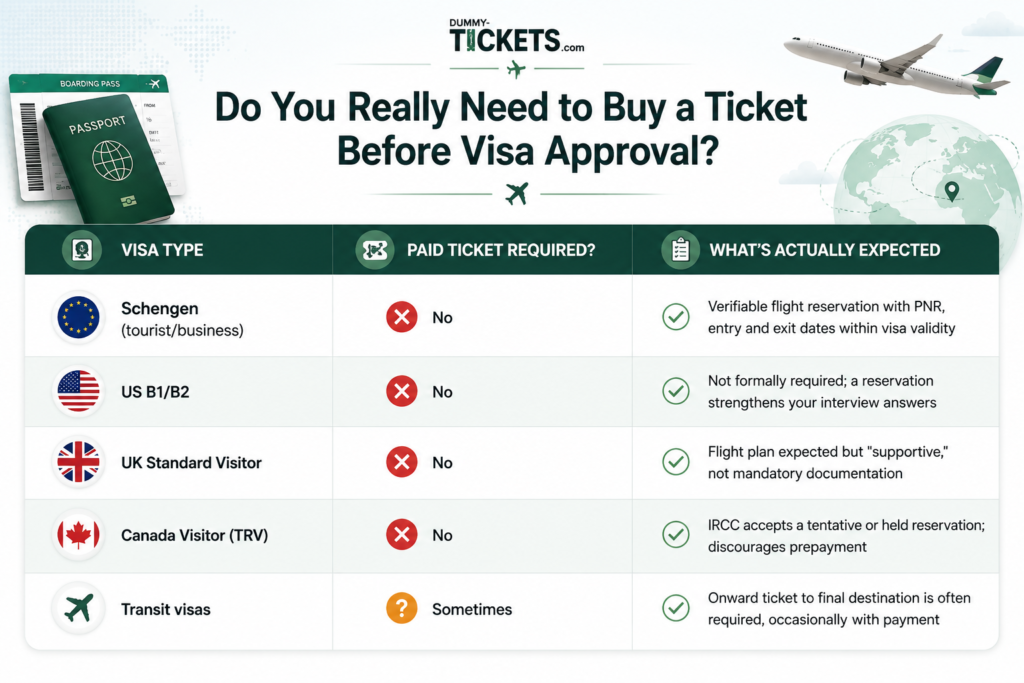
A few narrow exceptions exist — some consulates handling high-risk applicant pools, or specific transit visa categories, may ask to see a paid onward ticket. Always check your specific consulate’s published checklist, since requirements can vary even between consulates of the same country.
What a Valid Flight Reservation for Visa Must Include
Whether you book it yourself or use a reservation service, a compliant document needs:
- Full passenger name(s) exactly as they appear on the passport — middle names, spelling, and all.
- A real, verifiable PNR / booking reference that can be looked up on the airline’s official website.
- Airline and flight numbers for both outbound and return (or onward) legs.
- Departure and arrival airports, using correct IATA codes.
- Dates consistent with your visa application — your entry date should align with your stated trip start, and your exit date should fall within the maximum stay allowed.
- A round-trip structure in most cases — a one-way reservation alone rarely satisfies a tourist visa checklist, since it doesn’t demonstrate an exit plan.
Missing or inconsistent details on any of these points are among the most common reasons a reservation gets flagged during document review.
How to Get a Flight Reservation for Visa: 4 Methods Compared
| Method | Cost | Speed | Best For |
| Airline direct temporary hold | Often free–low cost | Minutes to hours | Travelers whose airline supports holds without payment |
| Travel agent reservation | $20–$50+ | Same day | Applicants who want a human to double-check details |
| Dedicated flight-reservation-for-visa service | $10–$20 | Minutes | Most applicants fast, affordable, purpose-built |
| Refundable ticket + cancel within 24 hours | Full fare upfront, refunded later | Instant document, refund takes days | Applicants confident about not needing to rebook |
Airline direct holds. A handful of airlines (particularly in the Middle East and parts of Asia) still let you place a reservation on hold for a small window without full payment. This produces a completely genuine PNR but isn’t available on every route or carrier.
Travel agents. A traditional agency can generate a hold booking for you, which is useful if you want someone to sanity-check your dates against your application before submission — though it’s usually the slowest and most expensive option of the four.
Dedicated reservation services. Because this need is so common, several services now specialize purely in generating real, temporary GDS bookings for visa purposes, typically for $10–$20, delivered within minutes. These are genuine reservations, not fabricated PDFs — the value is in the speed and low cost relative to a travel agent or a full-fare ticket.
Refundable ticket, then cancel. In the US, the Department of Transportation’s 24-hour rule lets you cancel a directly-booked ticket for a full refund within 24 hours of purchase, provided the flight departs at least seven days out. Some applicants use this to generate a “real” purchased ticket for a document pack, then cancel immediately after. It works, but it ties up your full airfare temporarily and depends entirely on booking directly with the airline rather than a third-party site.
Is a Flight Reservation or Dummy Ticket for Visa Legal?
Yes — with the same important caveat that applies everywhere in this space. A genuine flight reservation is a real booking that exists in an airline’s or GDS system and can be independently verified by anyone who looks up the PNR. Submitting one to an embassy in place of a paid ticket is standard, accepted practice, not a form of deception, because the reservation accurately represents what it is: a provisional booking, not proof of purchase.
What is not acceptable and what visa officers are specifically trained to catch is a fabricated document: an edited PDF, a screenshot doctored with fake dates, or a reference code that doesn’t exist in any real system. Consular staff can and do verify PNRs directly against airline databases. A reservation that fails that check doesn’t just get rejected, it can damage the credibility of your entire application and any future ones. The distinction is simple: real and temporary is fine; fake and unverifiable is not.
Country-Specific Flight Reservation Requirements
Schengen Visa Flight Reservation
All 29 Schengen states require proof of intended travel under the Visa Code. Your reservation should show a clear entry into and exit from the Schengen Area, with dates that don’t exceed your requested stay and that align with your travel insurance and accommodation proof consistency across your whole document set matters as much as the reservation itself.
US B1/B2 Visa Flight Reservation
A reservation isn’t formally required for the DS-160 form or the interview itself, but consular officers routinely ask applicants when and how long they intend to travel. Having a coherent, verifiable itinerary ready even if you’re not required to submit it — gives you a concrete, consistent answer rather than an improvised one.
UK Visa Flight Reservation
UK Visas and Immigration treats flight plans as supportive rather than mandatory evidence, but caseworkers use your stated dates to cross-check against your financial evidence and leave-of-absence letter. The official Standard Visitor guidance confirms applicants must be able to pay for a return or onward journey — not that one must already be purchased. A reservation that’s wildly inconsistent with the rest of your file can raise more questions than having none at all.
Canada Visa Flight Reservation
IRCC explicitly does not require a purchased ticket and generally expects a tentative travel plan alongside your other documentation. A held or reservation-style booking is standard and sufficient for most temporary resident visa applications.
How to Verify a Flight Reservation Is Real Before You Submit It
Before your reservation goes into your application, run this quick check yourself (the same verification logic covered in our PNR and booking reference guide):
- Visit the airline’s official website (not a third-party aggregator) and enter the PNR along with the exact passenger last name.
- Confirm the booking pulls up with matching flight numbers, dates, and route.
- Check that the reservation hasn’t already expired most holds are valid for 24 hours to a few weeks depending on the provider, so time it close to your submission or interview date.
- If you can’t verify it yourself in under two minutes, assume a visa officer won’t be able to either and that’s a red flag.
Common Mistakes That Get Visa Applications Flagged
- Buying a fully paid, non-refundable ticket “just to look serious.” It doesn’t improve your chances, and you lose the money if you’re refused.
- Submitting a one-way reservation for a visa type that expects a clear exit date.
- Letting the reservation expire before your interview or submission date, then forgetting to renew it.
- Dates that don’t match your other documents — insurance, accommodation, and financial evidence should all tell the same story.
- Using a free “ticket generator” that produces a PDF with no real PNR behind it — these are the documents most likely to fail verification.
Frequently Asked Questions
Do I need to buy a real flight ticket for my visa application? No. Nearly every major visa authority Schengen, US, UK, and Canada included explicitly advises against purchasing a non-refundable ticket before your visa decision.
What’s the difference between a flight reservation and a flight itinerary? In practice, embassies use the terms interchangeably. Both refer to a document showing your planned flights and dates, not a completed purchase.
Will a fake flight reservation get my visa denied? Yes, and it can go further than a simple denial a document that fails PNR verification can damage the credibility of your entire application.
How long is a flight reservation valid for a visa application? It depends on the provider or airline, ranging from 24 hours to a few weeks. Time your reservation so it’s still valid on your submission or interview date.
Can I use the same reservation for my visa application and my actual travel? Only if you convert it into a paid ticket after approval. Most applicants book their real flights separately, once the visa decision is confirmed and they can compare fares freely.
Final Thoughts
A flight reservation for visa purposes exists to solve a genuine problem: embassies need to see a coherent travel plan, but no reasonable applicant should have to risk hundreds of dollars on a ticket before knowing if their visa will even be approved. Once you understand that a verifiable, real reservation is what’s actually expected — not a paid ticket — the rest of the process is straightforward: get the details right, keep every document in your application consistent, and make sure your PNR is genuinely checkable.
If you’re assembling a full application package, it’s also worth reading our guides on Schengen visa document checklists, travel insurance for visa applications, and proof of onward travel at the airport — together they cover everything from your embassy submission to the moment you board.
Ready to Get Your Flight Reservation for Visa?
Don’t risk a non-refundable ticket on an application that hasn’t been approved yet. Get a fast, verifiable flight reservation with a real PNR, built to match your visa requirements — ready in minutes, not days. Book Now and submit your application with confidence.